
From the pre-op checklist to post-procedure recovery, surgical teams rely on precision, communication, and efficiency. But with today’s growing caseloads and staffing shortages, even small workflow gaps can add up to costly delays and clinician fatigue.
Now, artificial intelligence (AI) is helping to close those gaps, automating routine tasks, streamlining documentation, and empowering surgical staff to focus on what matters most: patient care.
Smarter Scheduling and Case Coordination
One of the most immediate uses of AI in surgical spaces is automated scheduling and resource allocation. AI algorithms can analyze historical case data, surgeon availability, and equipment usage to predict and optimize operating room schedules.
This means fewer last-minute cancellations and more consistent utilization, which is key for improving revenue and patient satisfaction.
In outpatient surgical centers, predictive analytics can also flag potential conflicts before they occur, helping administrators prevent downstream bottlenecks that disrupt throughput.
Sign up to get the latest industry news and offers right in your inbox
AI-Assisted Documentation and Communication
One of the most promising uses of AI in surgical settings is automating documentation, an area that often drains valuable clinician time.
Voice-enabled tools and generative AI systems can now listen during procedures or patient consultations, then draft accurate summaries, notes, and chart updates automatically.
A 2025 study published in JAMA Network Open found that when more than 1,400 clinicians began using AI tools that automatically generate clinical notes, they reported less burnout and greater overall well-being compared to before implementation.
For surgical teams, this means less time spent entering data and more time focused on patient care. AI-assisted note generation also helps improve accuracy, reduces after-hours charting, and speeds communication between departments—all of which contribute to smoother workflows and safer care delivery.

Read More: “Why a Nurse-Friendly EHR Is a Smart Investment for Your Surgery Center”
Predictive Maintenance and Equipment Monitoring
Surgical efficiency isn’t just about staffing; it’s also about keeping equipment ready when it’s needed most.
Across many surgical environments, AI-driven monitoring systems are now being used to track the performance of critical devices such as anesthesia machines and lighting systems, predicting maintenance needs before downtime occurs.
While not every piece of equipment is AI-connected, the principle remains the same: proactive maintenance protects workflow continuity. For procedure chairs and transport equipment, consistent upkeep and preventive service ensure safer, faster patient movement—and fewer delays when every second matters.
Real-Time Workflow Insights
Even with the best equipment in place, surgical efficiency depends on how teams move, communicate, and coordinate care.
AI-powered analytics tools are now helping surgery centers identify inefficiencies that aren’t always visible in the moment, such as turnover delays, supply restocking gaps, or extended patient transfer times.
By highlighting these workflow patterns, administrators can make informed changes that improve scheduling, staffing, and overall throughput.
When paired with reliable, easy-to-position equipment like Champion’s procedure chairs, these process improvements can translate directly into shorter room turnover times and smoother patient flow—without compromising comfort or care quality.

Read More: “How Hospital Systems Can Clear Out Costly AI Bottlenecks”
The T4 Procedure Chair: A Smarter Approach to Surgical Efficiency
Just as AI can enhance workflow precision, the right equipment can improve safety, speed, and patient experience.
Champion’s T4 procedure chair was designed with the same principles driving AI adoption—efficiency, adaptability, and care continuity.
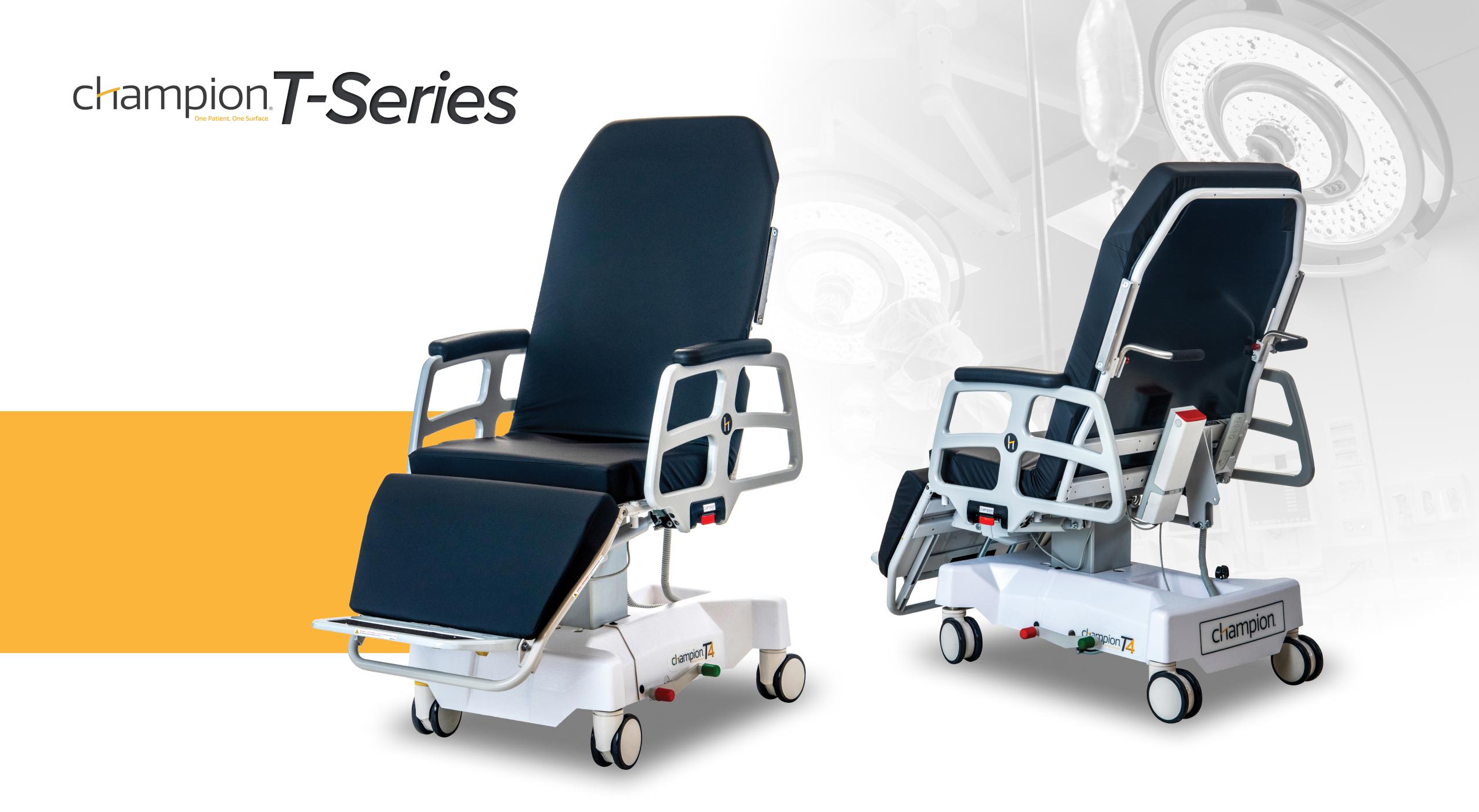
- Powered positioning with memory presets allows for seamless transitions between procedures, reducing patient transfers and minimizing injury risk.
- Compact footprint and mobile base free up valuable floor space while supporting quick navigation through tight corridors.
- Trendelenburg positioning and radiolucent back provide surgical flexibility across endoscopy, GI, and emergency applications.
- One Patient, One Surface® design means every step—from admission to discharge—can happen on a single surface, supporting both operational flow and patient comfort.
In busy surgery centers, small efficiencies make a big impact. The T4 helps teams move faster, safer, and smarter.
Take a closer look at the T4 and our full T-Series collection. Then, reach out to our team to see how Champion chairs can make your surgical workflows simpler, safer, and more efficient.