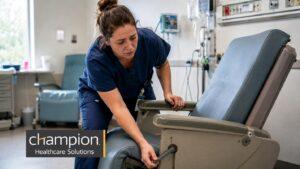
Nurse burnout is often discussed in terms of staffing shortages, long shifts, and emotional fatigue. But there is another factor healthcare leaders should not overlook: the physical environment where care happens every day.
For nurses, healthcare furniture is not just part of the room. It is part of the workflow.
When chairs are difficult to adjust, hard to clean, unreliable, or physically demanding to operate, those small points of friction add up. Over the course of a shift, a week, or a career, the equipment nurses use every day can either support the care team or make an already demanding job harder.
How Nurse Burnout Is Changing Patient Care Outcomes
Nurse burnout is no longer a background concern for healthcare administrators. As current healthcare industry analysis confirms, hospital systems are facing one of the most difficult operating environments in decades, with labor cost inflation, retention pressure, and a growing number of nurses considering leaving the profession.
When experienced nurses leave, facilities lose more than headcount. They lose clinical knowledge, team stability, and the confidence that comes from seasoned staff working at the bedside. The nurses who remain often absorb heavier workloads, which can further contribute to staff burnout and create a cycle that eventually reaches the patient experience.
For healthcare leaders, burnout prevention is not just a workforce initiative. It is a patient care strategy.
Physical Strain Nurses Face During Long Clinical Shifts
A typical 12-hour shift involves far more physical effort than most people realize.
Nurses spend hours on their feet. They assist with transfers, reposition patients, adjust equipment, clean between treatments, respond to urgent needs, and move quickly from one patient to the next. Over time, that repeated physical demand contributes to patterns seen across surgical and clinical settings.
That strain becomes even greater when the furniture nurses work with does not support the realities of care delivery.
A recliner that is difficult to reposition, a chair arm that limits side access, or a mechanism that requires extra effort may seem like a minor inconvenience in isolation. But when repeated across multiple patients and multiple shifts, these challenges become a real source of caregiver fatigue.
Nurse Burnout and Patient Safety Risks Are Linked
The connection between Nurse burnout and patient safety risks are directly correlated. When nurses are physically exhausted or emotionally depleted, it can affect observation, communication, patient education, and overall care delivery.
Burnout also affects morale, retention, and patient satisfaction. These are not isolated issues. They are connected to the way care teams experience their work environment every day.
That is why the physical tools used in care delivery deserve more attention.
How Your Facility Environment Drives Caregiver Fatigue
Poorly designed clinical environments can amplify the daily stress nurses already face.
When a recliner squeaks, jams, fails to hold position, or requires nurses to work around the equipment, the issue is not simply inconvenience. As documented clinical staff feedback confirms, malfunctioning furniture can create workflow inefficiency, frustration, and safety concerns.
The hidden cost of inadequate healthcare seating is not always visible on a purchase order. It shows up in staff frustration, slower room turnover, patient discomfort, and avoidable interruptions during care.
Facilities with aging or unreliable seating inventory may already be paying for those issues through lower staff satisfaction and increased operational strain.
Benefits of Smarter Healthcare Furniture for Care Teams
Healthcare furniture should be evaluated by how well it supports both patients and caregivers.
Modern healthcare furniture design measurably improves employee satisfaction when it is selected with the care team in mind. A chair that repositions smoothly, adjusts with minimal effort, holds securely, and allows better patient access can reduce both physical and cognitive workload.
That matters because nurses should not have to fight the furniture to deliver care.
When the chair works the way it should, nurses can focus more of their energy on the patient and less on managing equipment.
Recliner Features That Reduce Strain on Clinical Staff
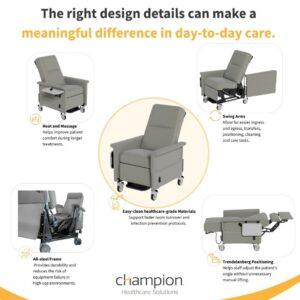
The right design details can make a meaningful difference in day-to-day care. Features that support nurses may include:
- Swing arms that move out of the way, allowing easier side access for transfers, positioning, and care tasks.
- Trendelenburg positioning that helps staff adjust the patient’s angle without unnecessary manual lifting.
- Heat and massage options that may help improve patient comfort during longer treatments.
- All-steel frames that provide durability and reduce the risk of equipment failure in high-use environments.
- Easy-clean healthcare-grade materials that support faster room turnover and infection prevention protocols.
These features are not just comfort upgrades. They are workflow tools.
Nurse Burnout Prevention Starts With Smarter Procurement
Nurse burnout prevention requires systemic intervention, and the physical tools nurses use every day are a legitimate lever.
For procurement teams, that means seating decisions should go beyond initial purchase price and patient comfort alone. Healthcare leaders should also ask how the chair supports caregiver access, repositioning, cleaning, durability, and long-term serviceability.
Moreover, with medical supply chain costs projected to increase 2.41% in 2026, durable and reliable seating becomes an even more important capital investment.
A power recliner that adjusts with one-touch controls is not a luxury in the right clinical setting. It can be a daily workload reduction for every nurse on that unit.
Care Settings That Benefit Most From Upgraded Seating
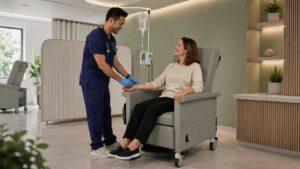
Some care environments carry especially high physical and emotional demands.
Oncology nurses face a uniquely demanding combination of long treatment sessions, frequent patient interaction, and emotionally complex care. Dialysis centers manage back-to-back multi-hour treatments that require repeated positioning and room turnover. Ambulatory surgery centers need procedure chairs that support efficient patient flow without adding unnecessary manual effort.
In each of these environments, seating should be designed to support the patient and the care team.
Investing in Ergonomic Seating Solutions Pays Off
Reducing nurse burnout requires a combination of strategies, including staffing support, scheduling practices, leadership engagement, mental health resources, and retention planning.
But the physical environment matters too.
Healthcare staff ergonomic seating solutions are a practical step facilities can take to reduce strain, improve workflow, and better support the nurses delivering care every day.
At Champion Healthcare Solutions, we believe medical seating should do more than provide a place for patients to sit. It should support the people delivering care.
Because when nurses are better supported, patients are better supported too.
Frequently Asked Questions
What Are the Top Nurse Burnout Prevention Strategies?
Effective nurse burnout prevention strategies include staffing support, scheduling improvements, mental health resources, leadership engagement, and environmental improvements. Reducing physical demands through caregiver-focused seating design and ergonomic equipment is one of the most practical steps a facility can take.
How Does Healthcare Furniture Choice Affect Burnout?
Chairs that require extra manual effort, limit patient access, fail during shifts, or lack functional design features can increase physical strain on nurses. Burnout compounds when environmental stressors go unaddressed, making reliable, ergonomic seating a meaningful part of a retention-focused facility strategy.
Which Champion Collections Work Best for Burnout-Focused Units?
The Premier Collection is well suited for high-acuity environments such as oncology and labor and delivery, with full feature sets including power positioning and comfort options.
The Select Collection balances performance and value for dialysis, infusion, and other high-use care settings.
The T-Series is designed for procedure and ambulatory care environments where efficiency, access, and patient flow are critical.
Ready to create a better care environment for your nurses and patients?
Explore Champion Healthcare Solutions seating designed to support caregiver workflow, reduce physical strain, and improve the overall patient experience. Contact us to learn how the right furniture can make a meaningful difference in your facility.