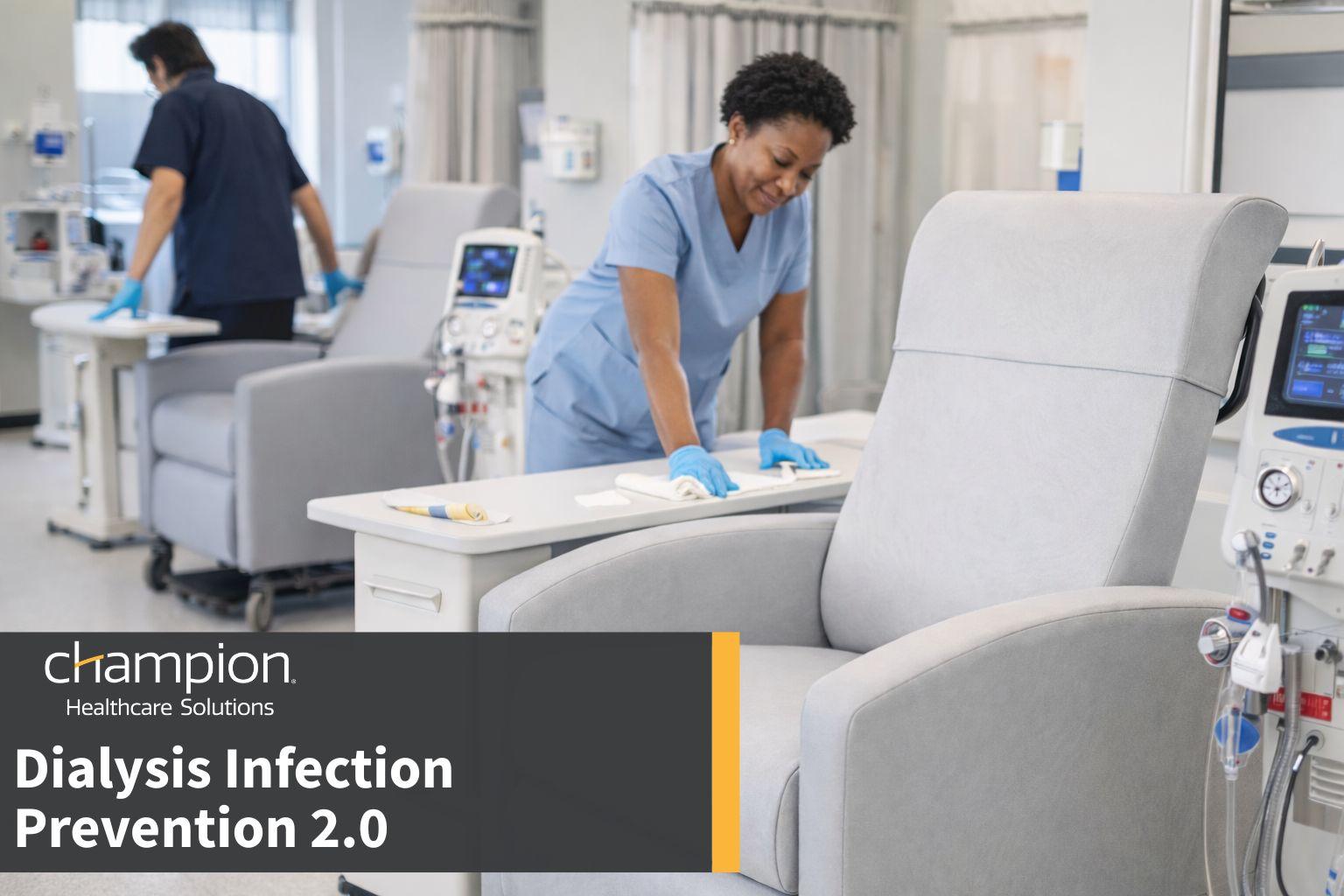
 Dialysis Infection Prevention 2.0: Designing the Dialysis Station for Fast Turnover, Audit Readiness, and Fewer Missed Surfaces
Dialysis clinics run on rhythm: arrivals, setup, connection, monitoring, disconnect, turnover… repeat. And in between every patient is the moment that matters most operationally: resetting the station safely, thoroughly, and consistently—even when the day is behind schedule and staffing is tight.
Infection prevention guidance for dialysis settings has been clear for years, but what’s changing is the operational reality: more pressure to document quality, fewer “extra” minutes in the schedule, and greater scrutiny on repeatable processes. CDC dialysis safety resources continue to emphasize preventing infection risk for an at-risk population, and CMS’s ESRD Quality Incentive Program (QIP) keeps quality performance (and payment) firmly tied to measurable outcomes.
This post is about environment-of-care workflow—not clinical care. We’ll focus on how to build an audit-ready turnover process, and why the chair is one of the simplest levers to reduce missed surfaces, speed up deep cleaning, and support a calmer patient experience.
Educational information only: This article discusses operational practices and environment-of-care considerations. It does not provide medical or treatment guidance.
Why this topic is trending in dialysis operations
1) Quality reporting pressure is staying front-and-center
CMS updates and measure specifications for the ESRD QIP are published by payment year, and the program reduces payments for facilities that do not meet performance standards (up to a maximum reduction).
Even when your clinical care is strong, inconsistent execution of high-frequency processes (like station turnover) can create preventable variability.
2) Dialysis infection prevention is still a high-consequence priority
CDC’s dialysis safety guidance consolidates resources designed to reduce infection risk in dialysis settings, and CDC also provides assessment and improvement tools for dialysis infection prevention programs.
3) Workforce strain turns “best practice” into a workflow design problem
When staffing is pressured, the solution isn’t “try harder.” It’s: make the right thing the easy thing—through station design, simplified steps, clear ownership, and equipment that’s built for frequent cleaning and fast access. AHA workforce analysis highlights continuing pressures that drive health systems to pursue efficiency gains and rethink how work is done.
The dialysis station “high-touch map” (where missed surfaces hide)
Most missed surfaces aren’t obvious—they’re where hands naturally rest, grip, and adjust.
One of the easiest ways to improve turnover consistency is to stop thinking “wipe down the chair” and start thinking “clean the touch map.”
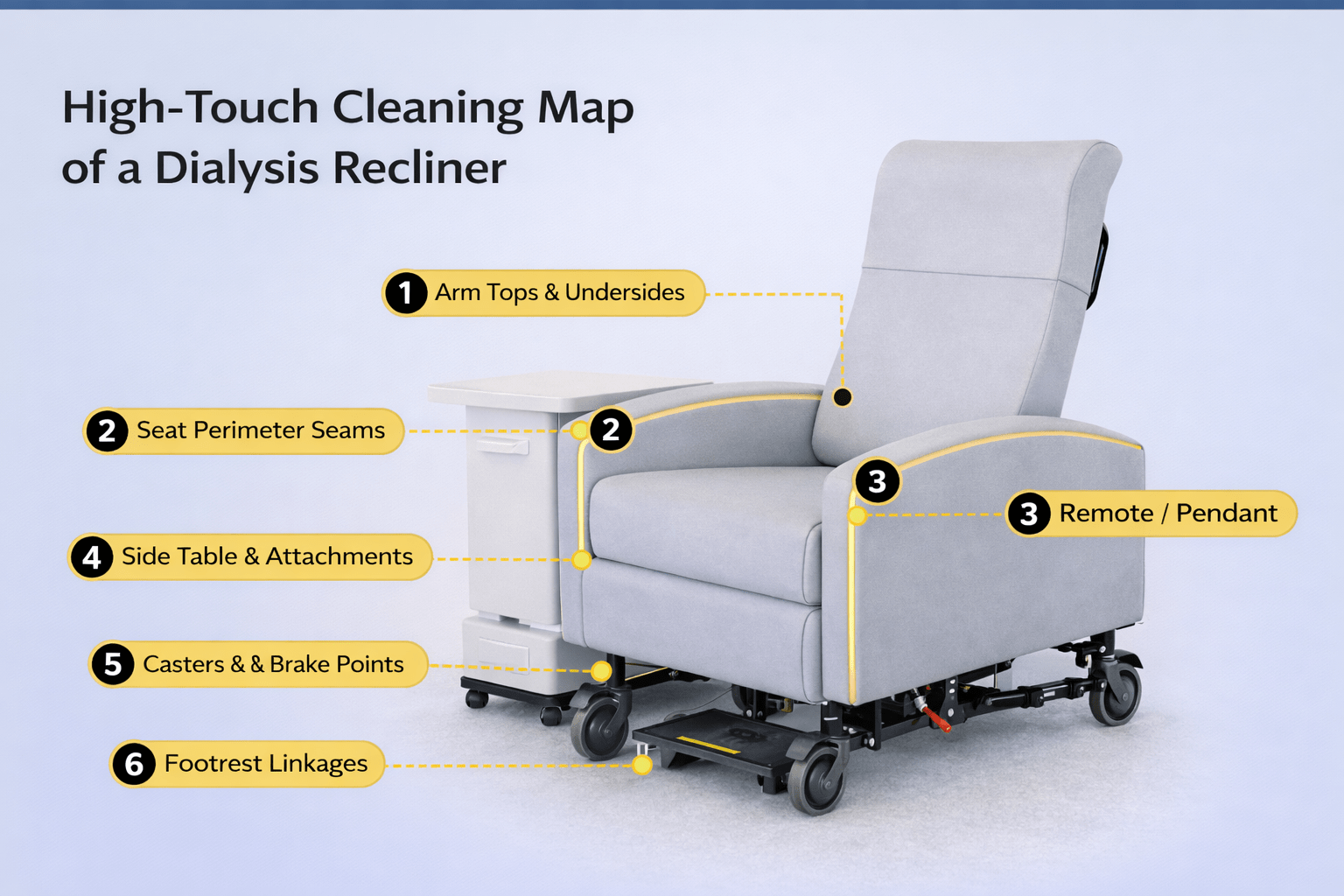
Here are common “missed surface” zones around dialysis seating and the immediate station:
Chair high-touch zones
- Arms: top surfaces and undersides/edges where hands grip during transfers
- Seat perimeter: front lip and side seams/creases
- Controls/pendants: buttons, cords, mounting points
- Footrest/legrest mechanisms: joints and edges that collect residue
- Handles and push points: anywhere staff naturally stabilize the chair
- Casters and brakes: high-contact points that roll through the environment
Station-adjacent zones that feel “separate” (but aren’t)
- Side tables/trays and attachment points
- BP cuff surfaces and cords (if stored at chairside)
- Call buttons/remotes
- Touchscreens or keyboards (where applicable)
- Any reusable accessory stored at the chair between patients
Pro tip: Turn this list into a simple one-page poster with photos from your own clinic. (Stock checklists are fine—but your equipment and flow will always be more convincing.)
Turnover under pressure: a process that survives the real world
Fast turnover isn’t the enemy. Unstructured turnover is.
The goal is a reset process that’s:
- Repeatable (same order every time)
- Assignable (clear “who does what”)
- Auditable (easy to spot-check)
- Trainable (easy for new or floating staff)
Step 1: Define ownership (clinical vs. EVS)
Many clinics do this informally—and that’s where variability sneaks in.
Write down:
- What EVS owns (e.g., floors, common touchpoints, trash/recycling, etc.)
- What clinical teams own (chair surfaces, clinical accessories, patient-contact zones)
- What’s shared (and how shared tasks are verified)
If your clinic already has strong cleaning protocols, align your station process with CDC’s broader best practices for environmental cleaning and disinfection so the logic behind the steps stays consistent.
Step 2: Use a “two-minute” verification loop
A quick signoff doesn’t need to be complicated:
- Visual indicator: “Ready for next patient” tag/card
- Quick spot-check: one high-touch chair zone + one adjacent zone
- Random audits: 1–2 per shift, rotated across stations
CDC also offers dialysis-focused tools that support assessment of infection prevention practices and quality improvement—useful frameworks to guide what you choose to observe and document.
Step 3: Remove friction from the workflow
If cleaning is hard, it won’t happen consistently on the busiest day of the month.
That’s where station design and equipment choice come in—especially the chair.
Seating features that support consistent cleaning (and faster deep cleans)
In dialysis, the chair isn’t just where patients sit. It’s a high-touch work surface used continuously all day.
When you evaluate dialysis seating through an infection prevention lens, look for features that reduce “hidden” spaces and make access easier—without adding steps.
1) Access-first design: make deep cleaning possible without disassembly headaches
Chairs designed with cleaning in mind often include components that help teams reach the places that typically get skipped.
2) Transfer-friendly features that reduce “extra touch”
Dialysis involves frequent ingress/egress and occasional assisted movement. When transfers are awkward, staff touch more surfaces—and the chair takes more wear.
The Classic and the Vero are built with swing-away arms for easier ingress/egress, positioning them well for long seated therapies where staff need access and patients need stability.
3) Materials and surfaces: choose a “cleaning-compatible” strategy
No surface is “maintenance-free.” The operational win is choosing upholstery and finishes that hold up to the cleaning products and frequency your clinic requires and then training cleaning methods around those choices.
“Read More: How to Prevent Hospital-Acquired Infections in Your Facility“
Not all treatment chairs are designed for real-world cleaning workflows.
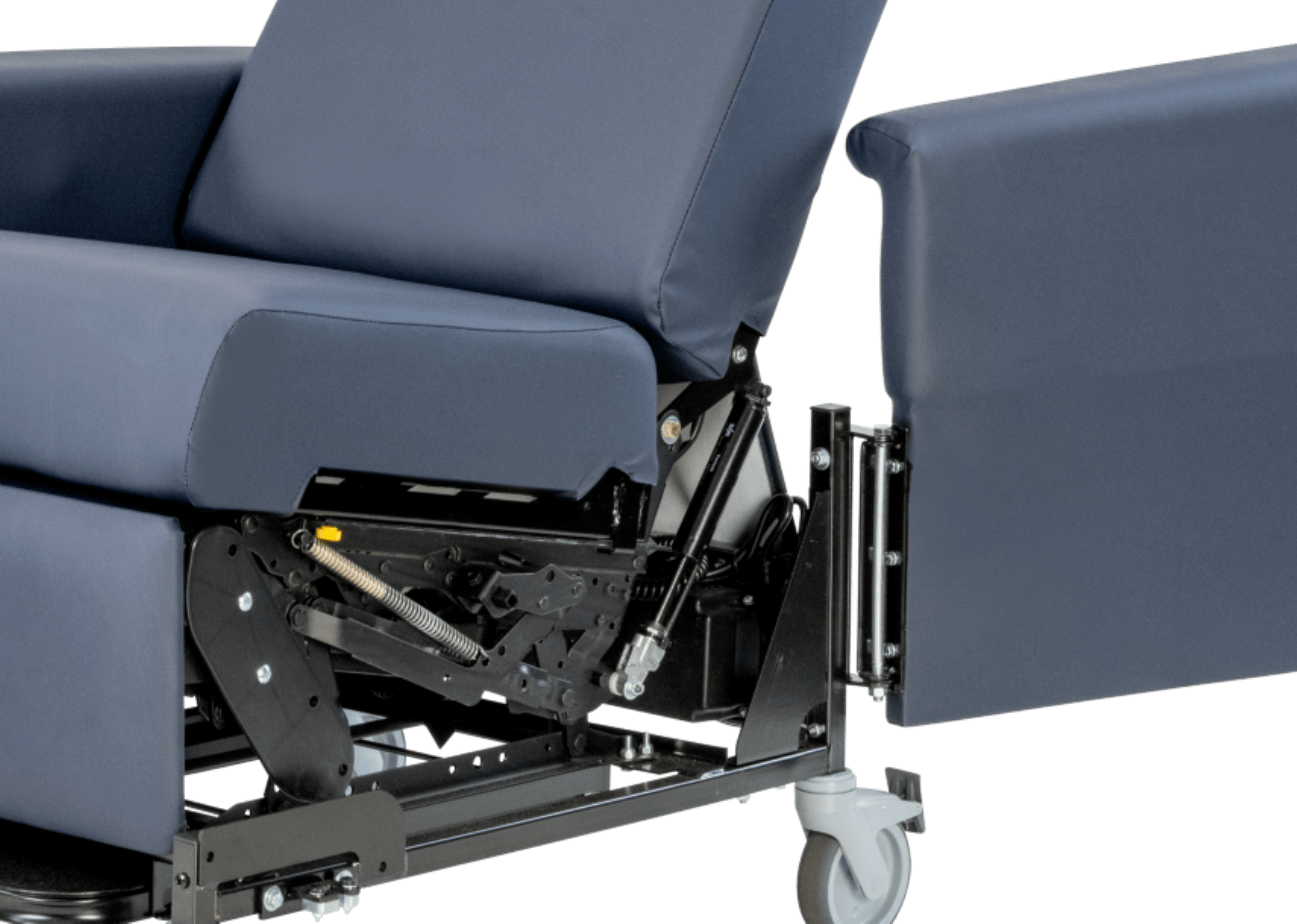 Features like swing-away arms and open access points make it easier for staff to clean hard-to-reach areas—supporting more consistent turnover.
Comfort isn’t a “nice-to-have” in long-dwell treatments—it’s operational
Dialysis treatments can involve long periods of seated time. Comfort affects:
- Patient satisfaction and perception of the environment
- Frequency of repositioning requests (which can interrupt staff workflow)
- Overall “smoothness” of the day
Champion’s infusion-space design content makes a strong parallel point: in long-haul treatment settings with back-to-back use, cleanability and turnover efficiency need to be designed in—not hoped for. That lesson translates directly to dialysis operations.
And if your organization is already thinking about next-generation treatment environments (including patient autonomy and comfort), you may find alignment with broader treatment-space design trends Champion has covered in oncology and infusion settings.
A practical Dialysis Station Turnover Checklist (copy/paste)
Use this as a starting point—then customize it to your clinic’s equipment and responsibilities.
Dialysis station reset (example workflow)
Clear & prep
- Remove disposables and visible debris
- Clear chairside table/tray surfaces
Clean the chair “touch map” (top to bottom)
- Arms (top + underside/edges)
- Seat perimeter (front lip + seams/edges)
- Controls/pendants (buttons + cord areas)
- Footrest/legrest surfaces and joints
- Handles/push points
- Casters/brake touchpoints (as applicable)
Clean station-adjacent touchpoints
- Tray/table surfaces and attachment points
- Call button/remotes
- Any reusable accessory stored at chairside
Verify
- Visual “ready” indicator
- Quick spot-check (rotate zones by day/shift)
- Document exceptions (out-of-service chair, torn upholstery, sticky controls)
What’s new here
Champion has previously explored dialysis’s broader operational challenges and solutions.
This post is intentionally narrower and more actionable: it’s a station turnover and audit-readiness playbook—built around high-touch mapping, ownership clarity, and seating features that make consistent cleaning more realistic.
If you’re building a dialysis content cluster on your site, this also pairs well with:
- Immunocompromised-environment considerations (cleanability emphasis)
- Acute care furniture design guidance on clean-out access and cleanability features
Where Champion chairs fit in a dialysis operational strategy
If your goal is faster turnover with fewer missed surfaces, seating is a practical starting point because it impacts:
- Cleaning access and consistency
- Transfer flow and staff touchpoints
- Long-duration comfort and patient experience
Two Champion chair options that map naturally to this dialysis operational story:
Vero
A strong fit for dialysis and other long-duration seated therapies, Vero is designed to support both patient comfort and infection prevention workflows. Features like swing-away arms provide unobstructed access to high-touch areas, making it easier for staff to clean thoroughly and consistently between patients. At the same time, improved access supports safer, more efficient patient transfers, helping reduce unnecessary strain on staff during high-frequency turnover.
For dialysis clinics focused on reducing variability in cleaning and improving station efficiency, Vero helps standardize the process without adding complexity.
Classic
The Classic chair is a dependable choice for facilities that prioritize durability, ease of cleaning, and day-to-day operational consistency in high-throughput dialysis environments. Its straightforward design supports repeatable cleaning workflows, with accessible surfaces that are easier to wipe down quickly and thoroughly during fast turnover periods.
For teams managing tight schedules and staffing constraints, Classic delivers a balance of reliability, comfort, and cleanability—helping maintain consistent performance across every shift.
Standardize the reset—then spec the chair to match the workflow
If your dialysis clinic is working to improve turnover efficiency, infection prevention consistency, or patient experience, seating is one of the few upgrades that impacts all three at once.
Champion can help you evaluate your current setup and standardize the right chair solution for your workflow, staffing model, and patient population.