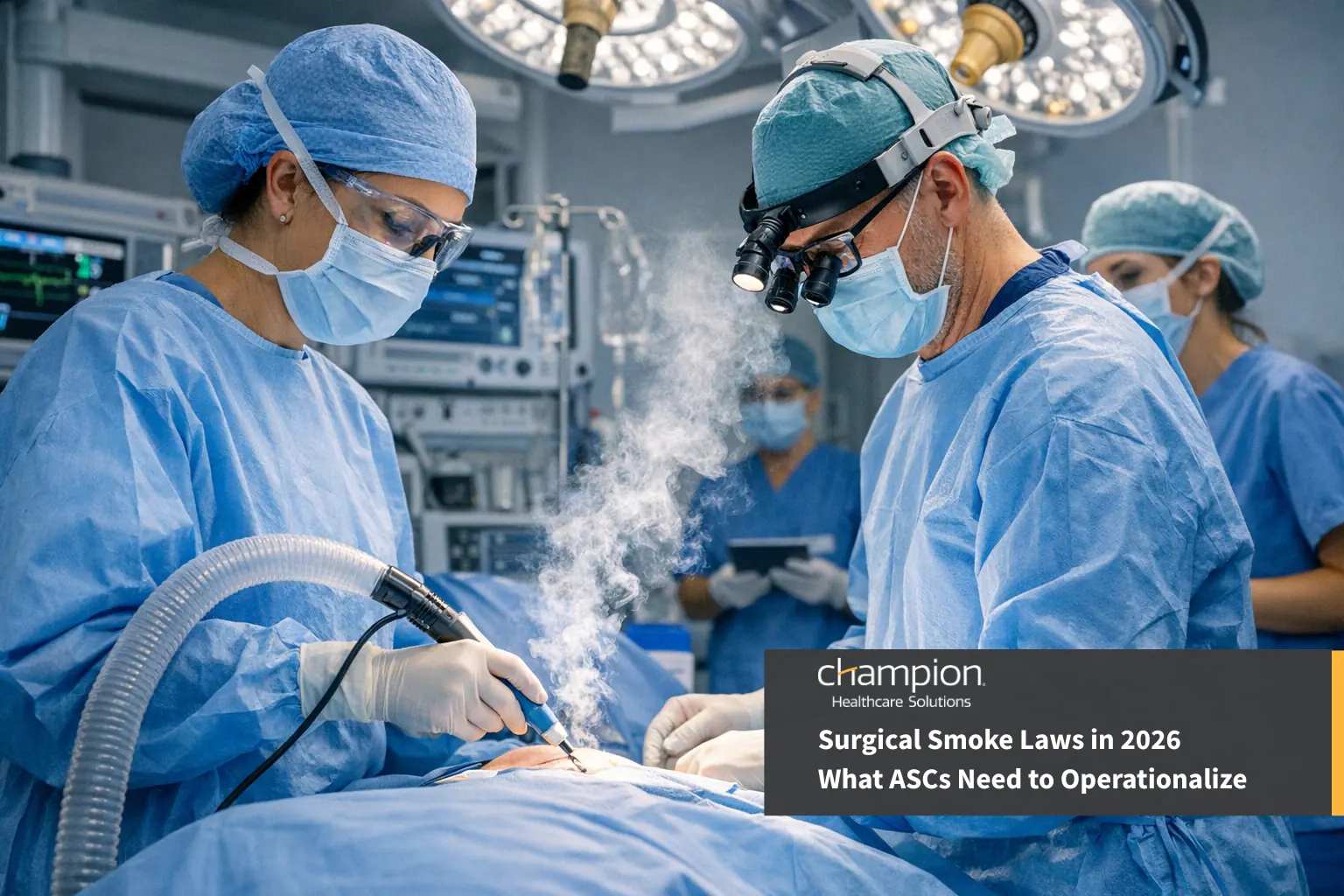
 Surgical smoke is no longer a recommendation—it’s a requirement. For ASCs, surgical smoke evacuation compliance is quickly becoming a critical operational priority. If you’re leading an ASC or hospital-based outpatient OR, you’ve probably felt the shift: surgical smoke is no longer treated as a “nice-to-have” safety initiative—it’s increasingly a compliance expectation with legislative momentum behind it.
In 2026, AORN reports surgical smoke evacuation legislation is under consideration in 11 states this legislative session (Florida, Hawaii, Iowa, Kansas, Maryland, Massachusetts, Michigan, Oklahoma, Pennsylvania, South Carolina, Wisconsin). And AORN’s broader advocacy hub notes 20 states have enacted surgical smoke evacuation legislation.
For ASC leaders, the takeaway is practical: equipment alone won’t get you across the finish line. Sustainable compliance comes from a program that’s easy to execute in real rooms with real turnover pressure—especially when staff are juggling multiple priorities.
Below is an operational playbook you can adapt—focused on workflow, role clarity, documentation, and room readiness.
Why surgical smoke is a “program,” not a purchase
Surgical smoke (plume) contains airborne contaminants and can pose health risks for OR teams exposed over time. National safety organizations have been consistent that exposure reduction depends on effective capture and work practices, not just awareness. For example, NIOSH engineering guidance emphasizes keeping capture close to the source and using controls during plume-generating procedures. The Joint Commission has also published awareness materials highlighting hazards and pointing organizations to NIOSH controls and safe work practices.
At the same time, the legislative landscape is evolving quickly. AORN’s policy agenda and legislative updates are clear: more states are moving from “recommended” to mandated smoke evacuation requirements.
Operationally, that means:
- You need a repeatable workflow (not “remember to do it”).
- You need training you can verify (not a one-time email).
- You need documentation that survives audits and staff turnover.
- You need a plan that works under ASC realities: rapid turnover, limited storage, limited staff redundancy, and tight schedules.
What’s changing in 2026 (and why it matters for ASCs)
AORN’s February 19, 2026 update highlights active legislative consideration in 11 states during 2026 sessions. Separately, AORN’s smoke-free OR page lists 20 states with enacted legislation (with requirements and effective dates varying by state).
Even if your state isn’t on the “new bills” list this year, ASCs are increasingly expected to:
- Demonstrate proactive staff protection practices,
- Align to recognized guidance (NIOSH work practices, ventilation controls),
- And operationalize smoke evacuation reliably across relevant procedures.
Important note: This article is educational and operational—not legal advice. Because state laws and enforcement vary, collaborate with your compliance/legal partners and reference your state’s current language and effective dates. (AORN’s ongoing updates are a strong starting point.)
The 6 components of a “sticky” smoke evacuation program
1) Policy that turns into room-level standard work
A policy that says “use smoke evacuation” is not the same as standard work that makes it happen. Building a program that supports surgical smoke evacuation compliance requires more than equipment—it requires consistency.
Make it executable:
- Define which procedures trigger smoke evacuation (e.g., plume-generating cases using electrosurgery/laser—using your facility definitions and state requirements).
- Specify the expected setup (what device, what tubing/filters, where it’s placed, when it’s turned on).
- Create a one-page “how we do it here” SOP that lives where staff work (preference cards, core binder, digital workflow).
NIOSH guidance stresses that capture effectiveness depends on proximity and active use during plume production—details that should show up in your local standard work, not just a generic policy.
ASC-friendly tip: Put the SOP into preference cards so the process appears automatically during case setup.
2) Role clarity (so it doesn’t become “someone else’s job”)
Programs break when tasks float between roles.
Define who does what:
- Surgeon: agrees to the standard; supports consistent use.
- Circulator: verifies setup and ensures the system is running when indicated.
- Scrub: positions capture components within the sterile workflow.
- SPD/Materials: ensures filters/tubing are stocked and rotated.
- EVS/Turnover: understands disposal steps and what gets changed between cases (as applicable to your equipment and IFU).
Make it visible: A simple RACI (Responsible / Accountable / Consulted / Informed) chart prevents “diffusion of responsibility.”
3) Training that’s observable (competency, not a slideshow)
You need training you can prove—especially with staffing changes, PRN staff, and new grads.
Consider a 3-step competency:
- Identify cases requiring smoke evacuation (per your policy).
- Set up correctly (including placement expectations per your equipment/IFU and your local SOP).
- Document correctly (where, how, and what counts as “done”).
NIOSH notes the importance of using controls during plume generation and disposal considerations for consumables—your competency should reflect the reality of use and change-out.
ASC-friendly tip: Build a 5-minute “skills check” into annual competencies—faster than remediation later.
4) Documentation and traceability (audit-ready without extra clicks)
Many facilities try to document everything—and end up documenting nothing consistently.
Keep documentation lean but defensible:
- Add a single field in your intra-op record: “Smoke evacuation used when indicated: Yes/No/N/A.”
- Tie it to case type or device usage when possible (e.g., electrosurgery used: Y/N).
- Track exceptions with a short reason list (equipment unavailable, emergent situation, surgeon preference conflict, etc.)—then fix the systemic cause.
AORN’s legislative updates make clear that expectations are moving toward consistent use—documentation is how you demonstrate “consistent” at scale.
5) Supplies + setup reliability (the “last 10 feet” problem)
Compliance fails in the last 10 feet when:
- filters aren’t stocked,
- tubing is missing,
- devices are shared across rooms without a clear staging plan,
- or the setup takes “too long,” so teams skip it to protect turnover time.
Solve reliability with logistics:
- Standardize a smoke evacuation “kit” (tubing + filter + any adapters).
- Place kits where rooms pull turnover supplies.
- Set par levels and a re-order trigger.
- Make it easy to grab the right thing without hunting.
ASC-friendly tip: If storage is tight, use a small, labeled bin per room or per cluster of rooms—don’t rely on “someone will run to central.”
6) Compliance monitoring that’s supportive (not punitive)
Programs stick when monitoring is about removing friction, not “catching” people.
Simple monthly scorecard ideas:
- % of indicated cases with documentation completed
- % of indicated cases with smoke evacuation used
- Top 3 barriers (by frequency)
- Time-to-fix for supply issues
NIOSH and other safety sources frame surgical smoke as an occupational exposure issue—monitoring helps you demonstrate continuous improvement, not just a one-time push.
Where smoke evacuation programs fail in real ASC rooms
Even strong policies struggle when the environment can’t support them. Common failure points:
- Cluttered rooms with limited staging space
- Device placement conflicts (cords, foot pedals, towers, anesthesia workspace)
- Turnover pressure that turns “optional steps” into skipped steps
This is where operational leaders can win: redesign the workflow so the right setup is the easiest setup.
Practical fixes:
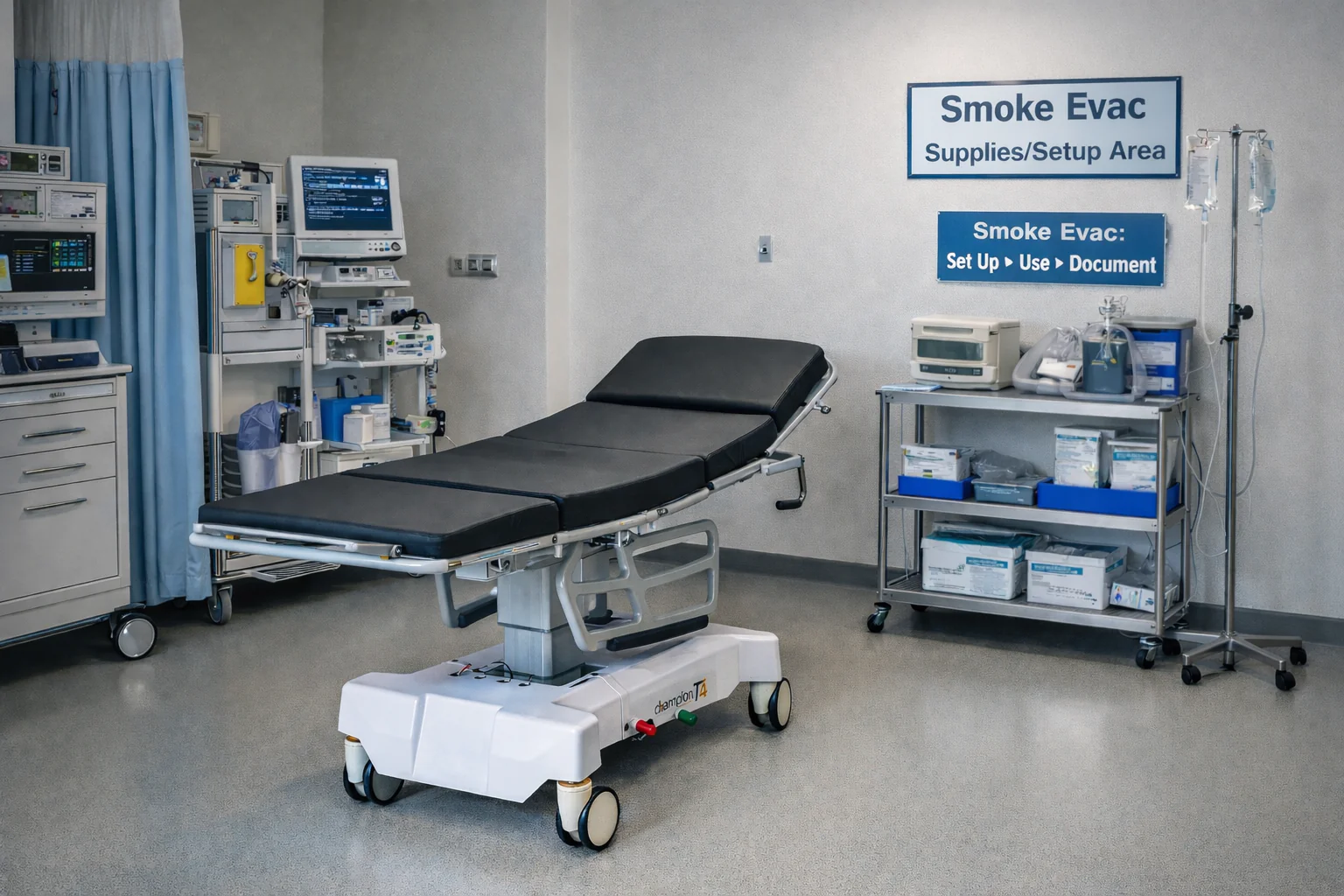
- Decide exactly where the device parks in each room.
- Standardize cable management.
- Include smoke evacuation setup as a checkbox in the room turnover flow.
- Build an “equipment ready” cue (e.g., staged tubing kit in the same place every time).
 Patient flow matters more than you think: reduce chaos to improve compliance
Smoke evacuation compliance often gets framed as “OR behavior,” but ASC leaders know behavior is downstream from flow.
When pre-op, procedure, and recovery processes are smooth and predictable, teams are less likely to cut corners to “make up time.” That’s why many facilities look at transfer reduction and space efficiency as part of broader workflow standardization.
Read More: How Procedure Chairs Are Changing the Face of the Surgical Space.
And if you’re evaluating procedure-room seating options specifically for surgical use cases, Champion’s overview of T-Series procedure chairs for surgical procedures is a solid starting point.
Why mention seating in a smoke evacuation article?
Because compliance initiatives succeed when the room is designed to support consistent practice—less congestion, fewer “workarounds,” and fewer time-squeeze moments.
A 30/60/90-day rollout plan (ASC-friendly)
This 30/60/90-day plan helps ASCs operationalize surgical smoke evacuation compliance without disrupting workflow.
Days 1–30: Build the foundation
- Confirm your state requirements and internal policy stance (compliance/legal input).
- Write the one-page SOP + add to preference cards.
- Define the RACI (role clarity).
- Standardize supplies (kits + par levels).
- Choose the documentation field(s).
Deliverable: SOP + preference card updates + supply plan + documentation field live.
Days 31–60: Train + validate
- Run short, hands-on competencies (setup + placement + documentation).
- Do quick observational audits (supportive coaching).
- Fix the top 2 friction points fast (often supply/placement).
Deliverable: Competency completion list + first scorecard + documented barrier fixes.
Days 61–90: Make it durable
- Formalize monitoring and feedback cadence.
- Add onboarding training for new hires and PRN staff.
- Review exception reasons and eliminate systemic causes.
- Consider a quarterly refresh: “what we changed based on your feedback.”
Deliverable: Ongoing dashboard + onboarding pathway + continuous improvement loop.
To make implementation easier, use this quick-reference checklist to ensure your program is audit-ready.
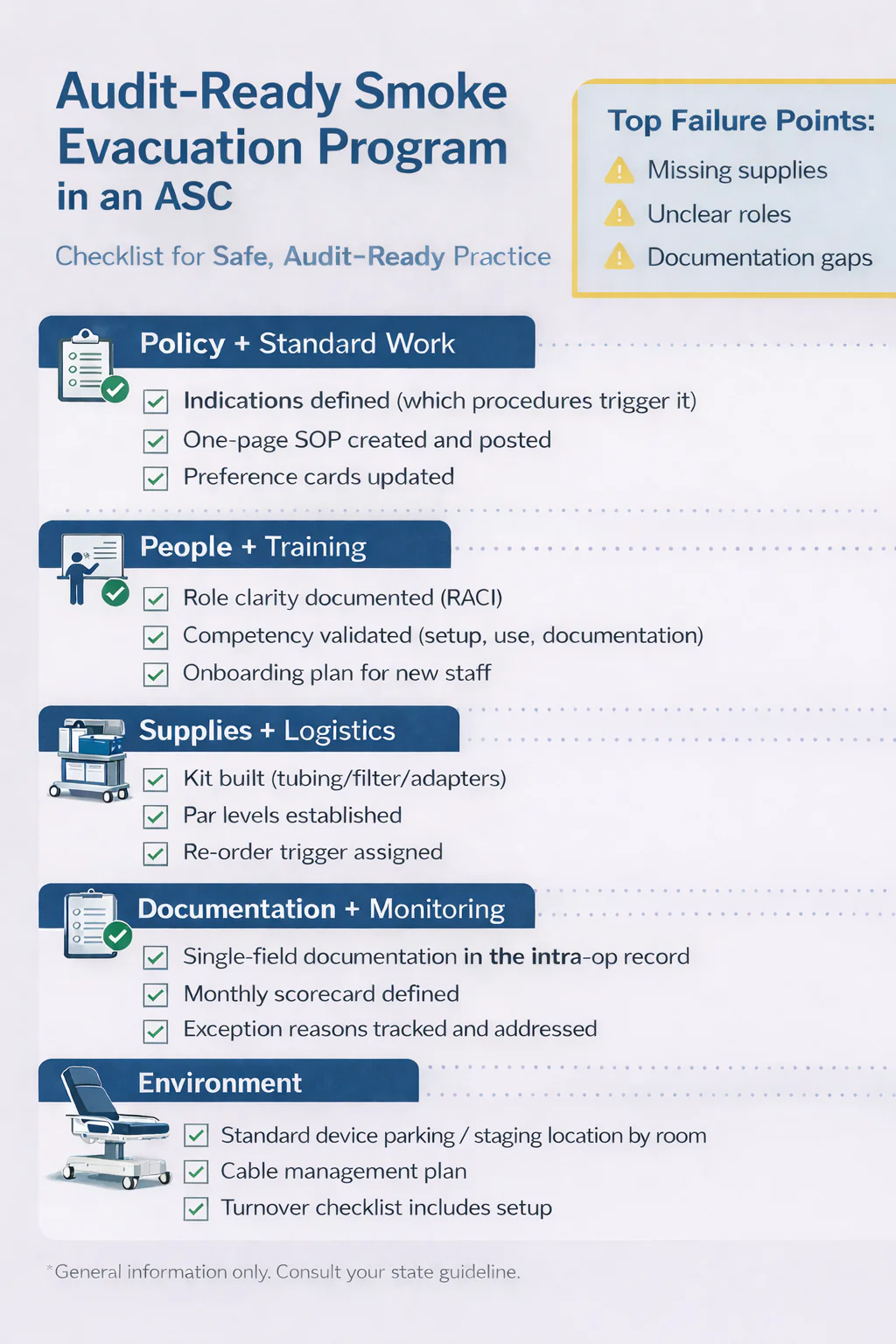
“Audit-ready smoke evacuation in an ASC”
Use this checklist to support surgical smoke evacuation compliance and ensure your program is audit-ready.
Policy + Standard Work
- Indications defined (which procedures trigger it)
- One-page SOP created and posted
- Preference cards updated
People + Training
- Role clarity documented (RACI)
- Competency validated (setup, use, documentation)
- Onboarding plan for new staff
Supplies + Logistics
- Kit built (tubing/filter/adapters)
- Par levels established
- Re-order trigger assigned
Documentation + Monitoring
- Single-field documentation in the intra-op record
- Monthly scorecard defined
- Exception reasons tracked and addressed
Environment
- Standard device parking/staging location by room
- Cable management plan
- Turnover checklist includes setup
Final thought: compliance that respects reality wins
Surgical smoke evacuation is moving toward broader legislative adoption and stronger expectations across the country. The ASCs that succeed won’t be the ones that simply “buy the system.” They’ll be the ones that build a program staff can follow on their busiest day—without heroics.
Want to reduce friction in periop flow while you standardize safety programs?
If you’re assessing ways to streamline perioperative movement, reduce transfers, and free up space in procedure environments, explore Champion’s T-Series resources: