If you’re buying medical treatment chairs for infusion suites, oncology centers, or ambulatory surgery centers (ASCs), you’re not just buying furniture. You’re buying patient safety, clinician workflow, infection-control readiness, service reliability, and predictable uptime.
In a world where supply chains keep getting tested—by tariffs, shipping disruptions, component shortages, and regulatory complexity—many providers are asking a simple question:
Should we prioritize USA-made equipment (especially high-use seating) over imports?
Based on what healthcare leaders, regulators, and supply-chain experts have been highlighting, the answer is increasingly: yes, when total value and clinical risk matter more than lowest upfront cost.
When you purchase a medical chair, you are selecting more than a product — you are selecting a supply chain.
The Hidden Role of the Chair in High-Throughput Clinical Care
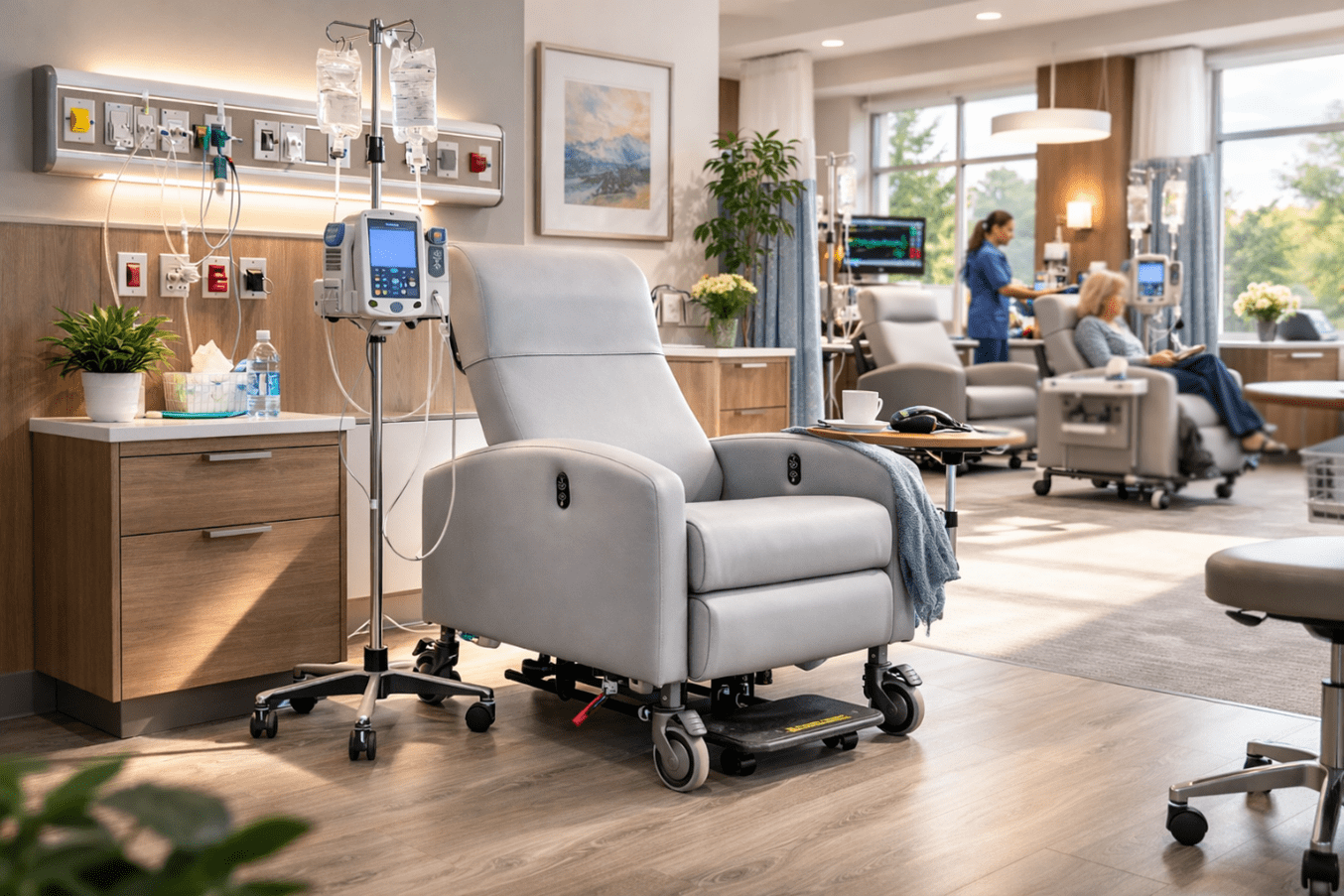
Treatment chairs in infusion and oncology centers endure constant use. Patients often remain seated for hours receiving chemotherapy, biologics, hydration, iron, or specialty infusions. ASCs depend on efficient patient flow and room turnover, where every piece of equipment plays a role in throughput.
A malfunctioning chair—whether due to actuator failure, worn upholstery, caster damage, or structural fatigue—doesn’t just inconvenience staff. It disrupts scheduling, reduces bay availability, and affects patient experience. In high-volume settings, even a single out-of-service chair can impact daily revenue.
Clinical seating is operational infrastructure. Reliability is not optional.
Read More: “Why Champion Chairs are Important to Infusion Therapy.”
What Trade and Healthcare Sources Are Warning About: Supply-Chain Uncertainty Is Real
Healthcare supply chain leaders have been navigating ongoing instability—and tariff policy has become a visible driver of uncertainty and cost variability.
One major example that made headlines: domestic production disruptions can cause nationwide shortages when capacity is concentrated—even for basic, high-volume items. That kind of fragility is exactly what providers are trying to avoid across categories.
And imports are a big part of the picture: the U.S. imports tens of billions of dollars of medical devices and supplies annually, making providers vulnerable to policy shifts, port delays, and overseas manufacturing bottlenecks.
Bottom line: when you buy a treatment chair, you’re buying into a supply chain. Domestic manufacturing can reduce risk—especially for high-use clinical seating where service and parts matter.
Why USA-Made Medical Treatment Chairs Reduce Operational Risk
Service Speed and Issue Resolution
In high-volume clinical environments, downtime is expensive. A chair waiting on a replacement part from overseas may sit idle for weeks. During that time, staff adjust schedules, shuffle rooms, and attempt temporary workarounds.
Domestic manufacturing significantly improves responsiveness. Replacement parts can be shipped faster. Technical support teams operate within the same time zones. Engineering and production teams remain accessible.
This responsiveness directly impacts operational continuity in infusion suites and ASCs.
Total Cost of Ownership vs. Purchase Price
Procurement decisions in healthcare increasingly focus on total lifecycle cost rather than initial purchase price alone.
When evaluating medical treatment chairs, facilities should consider:
- Expected lifespan under high utilization
- Upholstery durability under hospital-grade disinfectants
- Frequency of service events
- Downtime cost per treatment bay
- Parts availability after 5–7 years
- Staff time required for workarounds during equipment failure
A lower upfront price may appear attractive — but if downtime increases or replacement cycles shorten, the long-term cost may exceed the savings.
USA-manufactured equipment often delivers stronger lifecycle predictability, especially when paired with structured service programs.
Built for Clinical Demands, Not Adapted from Furniture
Treatment chairs in oncology and infusion environments must support long-duration comfort, caregiver access, infection prevention protocols, and repeated disinfection cycles. Clinical seating should be engineered specifically for healthcare workflows.
Facilities evaluating seating for oncology and infusion environments should focus on clinical functionality, infection control compatibility, caregiver access, and long-term durability.
Read More: “10 Key Considerations When Choosing Medical Seating for Oncology Treatment Centers.”
Champion’s oncology and infusion chairs offer features such as Trendelenburg positioning, swing-away arms for safer lateral transfers, durable steel frames, and modular construction designed for serviceability. These chairs are manufactured in the United States under an ISO 13485–aligned quality system.
These engineering decisions matter in environments where chairs are used daily, cleaned repeatedly, and expected to last for years.
Risk Management in an Era of Healthcare Volatility
Organizations such as ECRI continue to warn healthcare leaders about supply-chain risks and the importance of proactive procurement strategies. Equipment reliability is part of that broader risk landscape.
A treatment chair may not appear critical until it fails during peak volume.
In infusion, oncology, and ASC environments, reliability, documentation transparency, service responsiveness, and supply-chain stability are interconnected.
Champion Healthcare Solutions: USA Manufacturing with Service Alignment
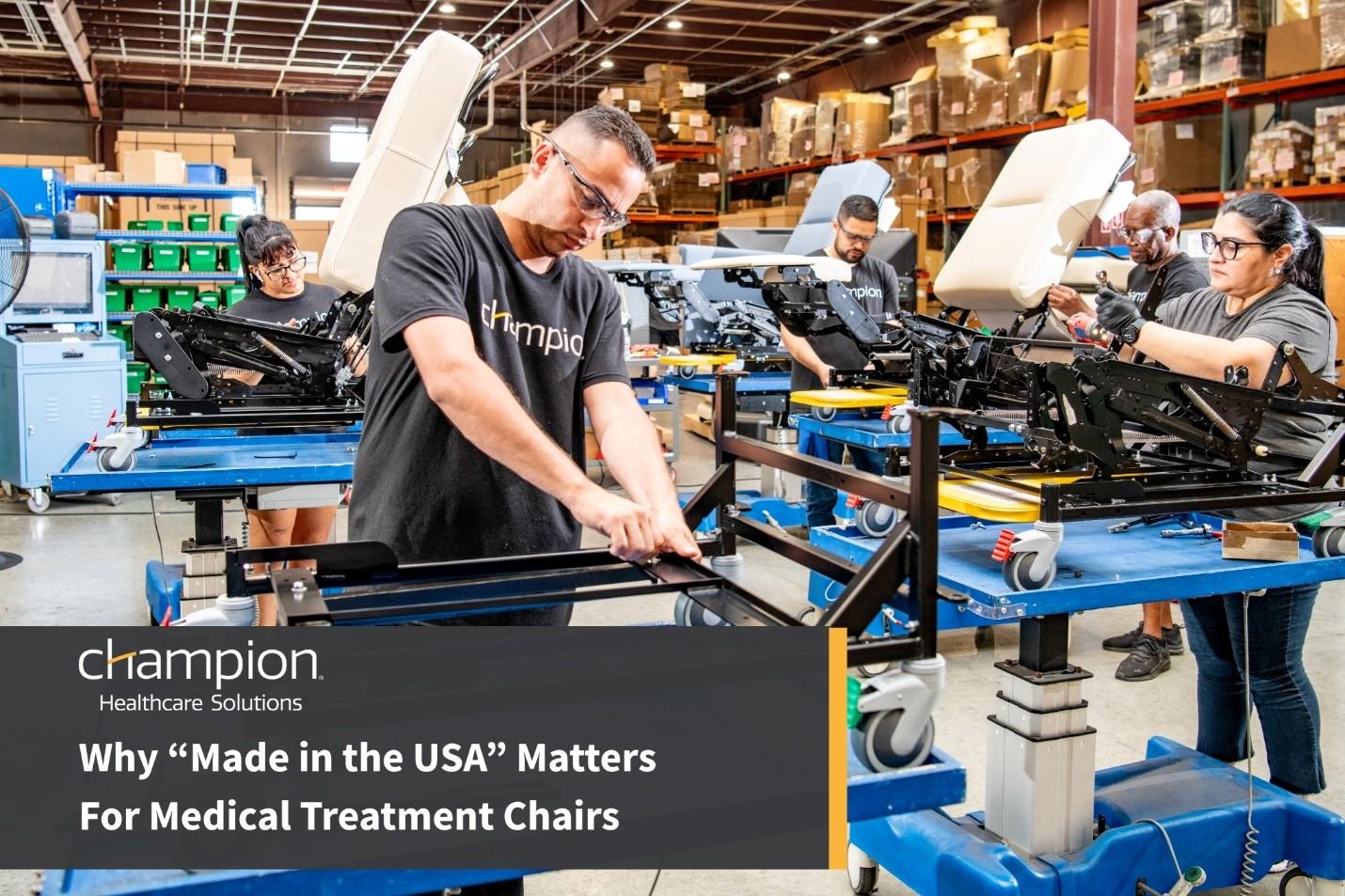
Champion Healthcare Solutions manufactures its treatment chairs in the United States, with production facilities supporting both manufacturing and service infrastructure.
Champion Service Plus (CS+) was developed to support healthcare facilities where equipment downtime is not acceptable. Because Champion chairs are manufactured in the United States, service coordination remains closely aligned with engineering and production teams.
CS+ provides structured support that includes rapid parts fulfillment, dedicated communication channels, warranty support options, and preventive maintenance guidance. When issues arise, facilities are not navigating overseas supply chains or extended international shipping cycles.

The benefit of domestic manufacturing becomes tangible during service events. Parts availability is more predictable. Engineering input is accessible. Resolution timelines are shorter. For infusion suites and ASCs operating on tight daily schedules, that responsiveness supports operational stability.
By pairing domestic production with Champion Service Plus, facilities gain:
- Faster issue resolution
- More predictable parts access
- Direct communication with U.S.-based support teams.
- Structured lifecycle management
USA-made clinical seating is not a branding choice. It is a strategy to reduce uncertainty.
When Should You Prioritize USA-Made Medical Seating?
Healthcare organizations should strongly consider USA-made treatment chairs when:
- Uptime directly affects revenue
- Expansion timelines are tight
- Standardization across multiple facilities is required
- Service infrastructure and parts availability are mission-critical
- Total cost of ownership matters more than lowest bid pricing
In infusion suites, oncology centers, and ASCs, treatment chairs are not decorative assets. They are clinical infrastructure.
Choosing USA-made medical treatment chairs — supported by aligned manufacturing and service programs like CS+ — helps protect uptime, strengthen documentation confidence, and reduce exposure to supply-chain disruption.
When throughput, patient experience, and operational stability matter, manufacturing location becomes part of your clinical strategy.