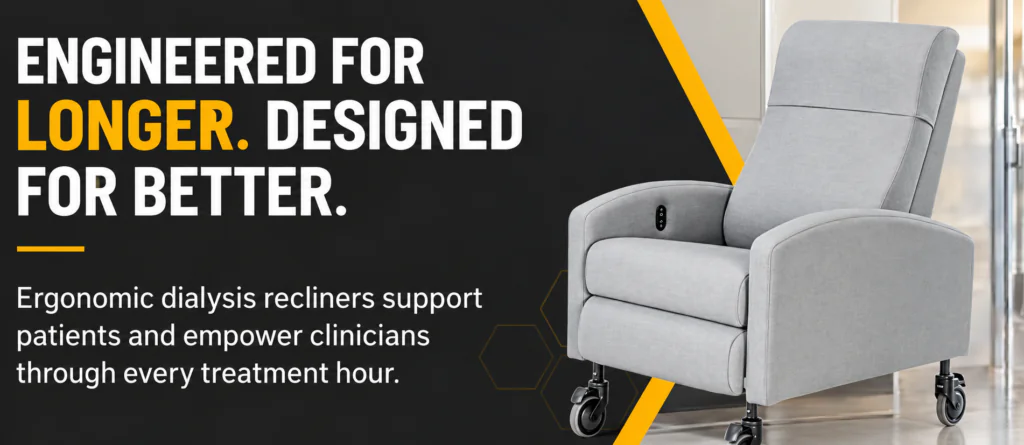
Choosing an ergonomic dialysis recliner affects every treatment hour your patients and staff experience. This guide walks dialysis directors and procurement managers through the factors that matter most: sustained positioning, pressure redistribution, safe transfers, bariatric needs, infection prevention, and the specifications that belong on every buyer’s checklist.
What Ergonomic Means in Clinical Seating and for Dialysis Recliners
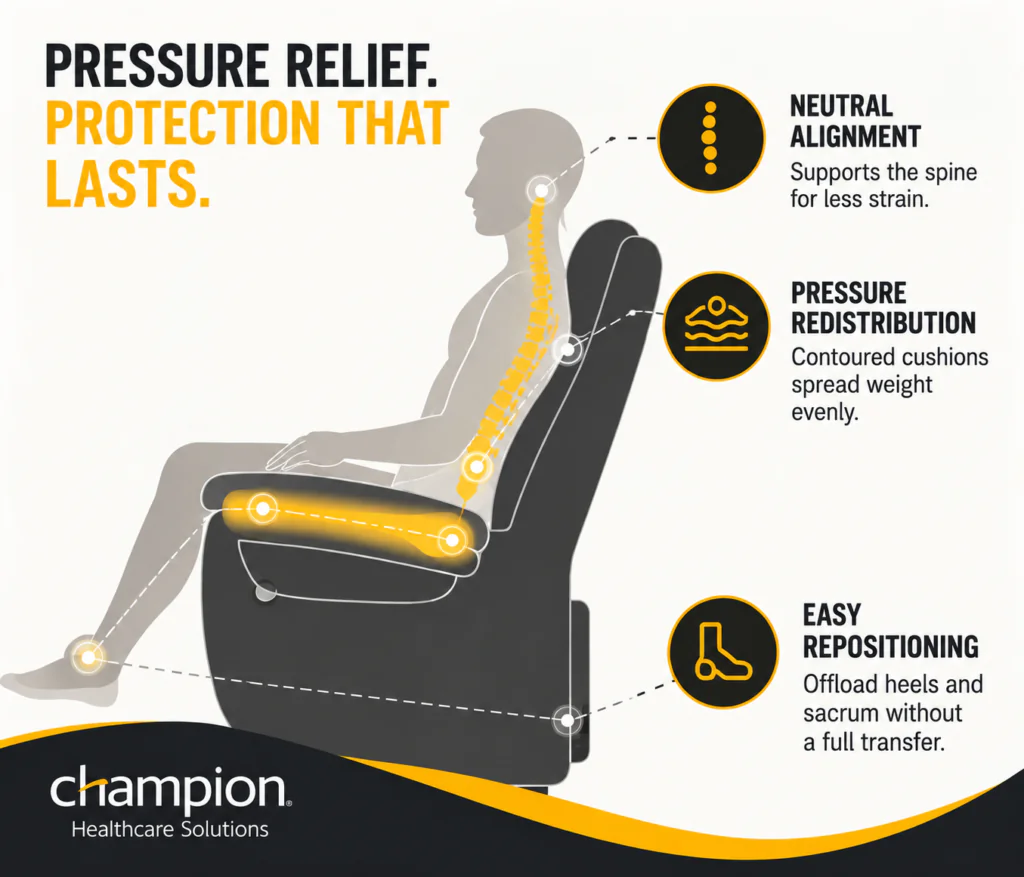
In clinical seating, ergonomic design means a chair is engineered around the human body and the way care is realistically delivered. That means supporting neutral spinal alignment, distributing pressure evenly, and adjusting to different patient sizes and conditions. Just as important, the chair must reduce the physical strain placed on the clinicians who work around it every day, because their wellbeing matters as much as the quality of the chair itself.
For dialysis, the bar is set higher because patients remain seated for hours at a time. A dialysis recliner built with real ergonomics should offer several key features that support patient comfort and help caregivers work safely:
- Smooth multi-position adjustability to accommodate different patient needs throughout treatment.
- Supportive lumbar and leg positioning to promote proper alignment and comfort during extended sessions.
- Soft, high-density padding to help distribute weight evenly and reduce discomfort.
- Swing-away arms for easy patient-access so caregivers can reposition patients without awkward lifting or reaching.
- Transport component of the dialysis chair allows for easy rolls to the scale and back to treatment bay.
Easy access reduces the number of lateral transfers, and patient-controlled positioning allows caregivers to attend to treatment while patients can adjust the chair to match their preferred comfort. All of these reasons prove why seating is a capital decision for U.S. dialysis centers.
Core Features of Clinical-Grade Dialysis Seating
Clinical seating starts with a baseline of features that hold up under daily use. In our experience, these are the specifications worth confirming before you compare price:
- Easy recline: A recliner that lets staff and patients adjust smoothly without labor-intensive or time-consuming effort.
- Trendelenburg positioning: This is essential for responding quickly to intradialytic hypotension, which affects up to 30% of patients, so powered positioning is a critical requirement in emergency situations.
- Swing arm: Allows for easy patient ingress and egress—as well as deep clean access to reach potential fluid contaminants without having to remove the chair from service.
- All-steel frame: Delivers long-term durability that lighter frames cannot match.
- Comfort options: A heated seat and massage function help patients tolerate long sessions.
Manual and battery-operated units behave differently, and clinics must determine their patient and provider needs in order to clarify which one best fits their workflow. Champion offers chairs with emergency battery back-up that run for a limited number of cycles, so you have what you need—even in a pinch. Browse Champion Healthcare Solutions’ dialysis medical recliners to see our features and specs.
Where an Ergonomic Solution Earns Its Place Over Thousands of Treatment Hours
For long treatment sessions, an ergonomic dialysis recliner must support the body through many hours without forcing patients to compensate. Poor alignment turns into back pain by hour two, which is why it’s essential to offer contoured lumbar support and a cervical rest that keeps the spine neutral.
Additionally, a heated seat and gentle massage function ease the stiffness that creeps in around hour three, when patients start shifting in their seats and glancing at the clock.
A well-designed footrest and armrest design also make a big impact, because small ergonomic gaps compound over thousands of treatment hours. Consider the patient who has sat in the same chair three times a week for years: The details that feel minor on day one become the difference between simply tolerating a session and genuinely appreciating their treatment clinic.

Prevent Pressure Injuries Through Seating Design
Patients with limited mobility, diabetes, or poor nutrition face real risk of sacral and heel injuries during long sessions. Pressure injury prevention should be built into the chair, not left to staff vigilance alone.
Comfortable cushions made with high-density foam spread a patient’s weight evenly across the seat and back, which reduces pressure on vulnerable areas. Deeper and wider seats safely and comfortably accommodate bariatric patients.
It’s important to consider all body types, and patient comfort isn’t just about weight and size capacity. Many dialysis patients have endured medically necessary amputations, and treatment chairs must be designed with this in mind.
Dialysis Chair Fall Prevention and Safe Patient Transfers
Falls are a serious concern for people living with kidney disease, and a multicenter study of 820 hemodialysis patients found a 22.8% fall rate, which shows why medical seating should be treated as a safety control. Effective dialysis chair fall prevention rests on a stable, anti-tip frame, locking casters, and secure footrest mechanisms that don’t shift under load.
Armrest design also plays a key role. Sturdy, well-positioned arms give patients something solid to push from, while swing-away arms clear the way during transfers. Staff feel the difference too: Ask any dialysis nurse about the lifting and leaning they do across a full shift, and you will hear how quickly small strains add up, which is why a chair that does more of the work itself protects both patients and caregivers. Because fall risk rises when patients are tired or lightheaded after treatment, the chair should let them sit stably at the edge before standing, and chair-stand performance and ingress/egress height are linked to measurable fall risk.
Dialysis Chair Higher Height Benefits
A dialysis chair with a higher height makes a difference for caregivers and their own posture needs. Nurses can work at a comfortable level for cannulation and line checks, which improves comfort for the care team and reduces bending. For facilities mindful of accessibility, a low-entry design also aligns with ADA-conscious planning. Read more about designing chairs with caregiver ergonomics in mind.
Sizing, Weight Capacity, and Bariatric Seating Needs
An estimated 30 to 45% of hemodialysis patients live with obesity, so your chair mix must reflect your actual population. A single standard size will leave some patients cramped and others unsupported.
|
Seating type |
Best suited for |
Key consideration |
|
Standard |
Most patients in a typical center |
Confirm rated weight capacity |
|
Extra-wide |
Patients needing more seat room |
Check chair dimensions against floor space |
|
Bariatric recliner |
Higher-weight patients |
Verify tested ratings and frame strength |
Always ask for tested weight capacity, not an estimate, and confirm that the frame, recline mechanism, and swing arm all meet the stated rating. Our guide to choosing medical seating offers a broader framework for matching chairs to your patient mix.
Upholstery, Infection Prevention, and Cleaning Protocols
Because dialysis involves blood and fluid exposure, upholstery choices are more than aesthetics or even patient comfort. They are also infection prevention decisions. When you select an ergonomic dialysis recliner, look for seamless vinyl or a rolled seam. This careful seam construction leaves fewer places for fluids to collect. Also look for fluid-resistant finishes and coated medical-grade textiles that simplify turnover between patients.
Antimicrobial upholstery adds another layer of protection, and Champion’s Secura performance fabric is one option built for demanding clinical environments. Whatever you choose, confirm it tolerates your disinfectants, since harsh cleaners can crack inferior materials over time. Our recliner cleaning instructions and dialysis infection prevention practices help you align cleaning protocols with your chair finishes when choosing Champion.
Procurement Checklist: Specs, Warranty, and Configuration
A disciplined checklist keeps purchasing objective, whether you are outfitting a new outpatient clinic or replacing aging chairs across a national network. Champion suggests you evaluate each candidate against the same criteria:
- Frame construction: Confirm an all-steel frame and ask how it is tested.
- Warranty coverage: Compare terms on frame, mechanisms, and upholstery; see our warranty information.
- Collection tier: Review the Premier Collection and Select Collection for feature differences.
- Lead times and bulk pricing: Ask what applies to multi-chair orders.
- Quality systems: Understand why a quality management system matters.
When you are ready to specify, use Champion’s virtual configurator to build your chair with your preferred fabrics and features, then contact a rep to finalize your order.
Frequently Asked Questions
What features make a dialysis recliner ergonomic?
A suitable dialysis recliner combines lumbar support, pressure distribution, easy access and adjustment, Trendelenburg positioning, and a durable all-steel frame. Matching these features to your patient population matters more than any single specification.
How does ergonomic design affect patients and staff?
Seating influences patient safety and comfort, infection prevention, and staff workload. Evaluating weight capacity, height specs, upholstery, and warranty coverage upfront prevents costly replacements and keeps your center running efficiently.
Why is an ergonomic dialysis recliner important for long treatment sessions?
Patients sit in these chairs for hours, several times weekly. Poor design contributes to pressure injuries, falls, and fatigue, while a well-specified chair supports better treatment experiences and safer, more efficient care.
Selecting an ergonomic dialysis recliner is one of the most consequential equipment decisions a dialysis center makes. If you need assistance finding the right dialysis chairs for your patient population or facility customers, reach out to one of our medical seating experts today.